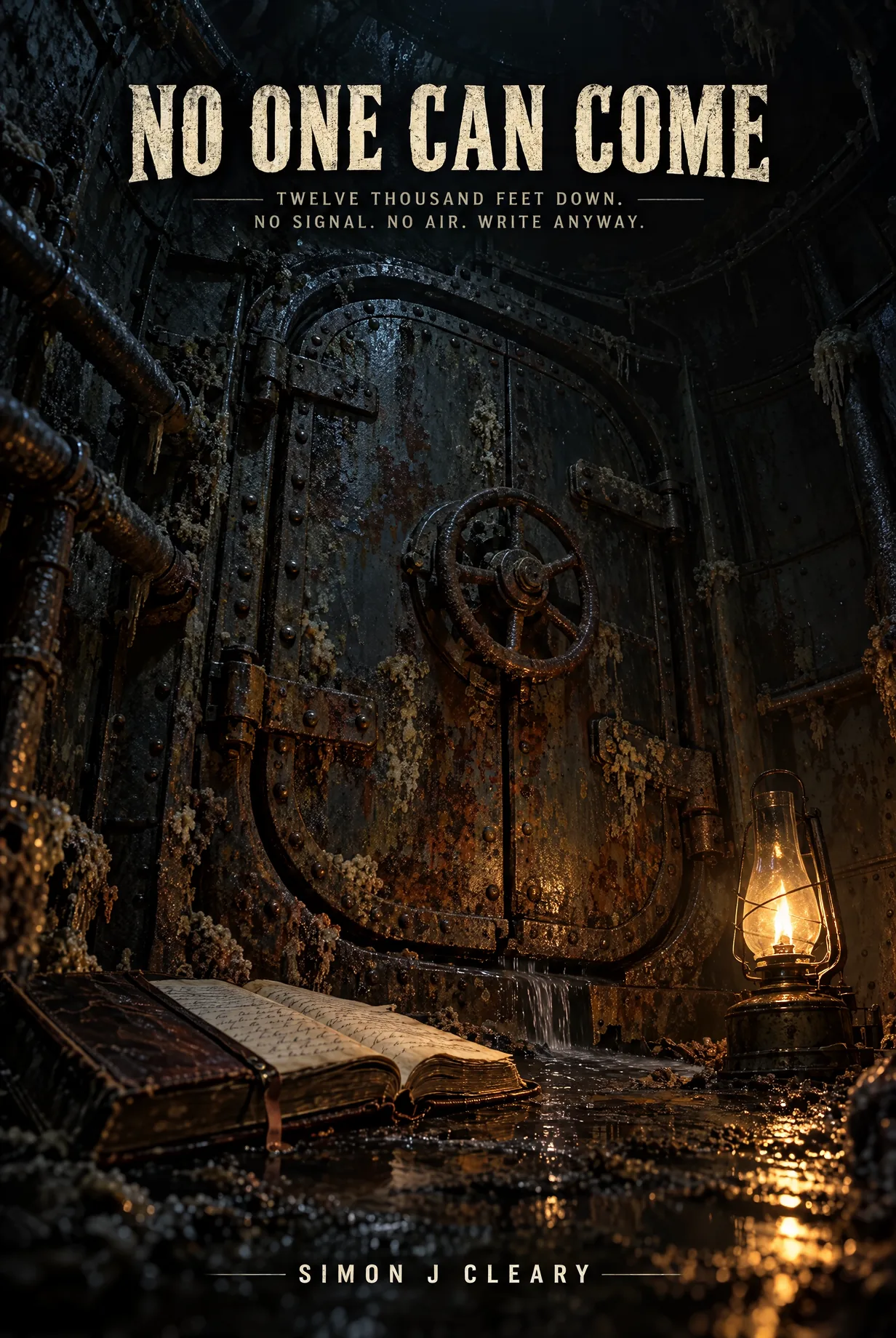
From his debut novel. Text may differ from the published edition.
The pencil would not make a clean line on the damp paper. Pym rubbed the heel of his hand across the back of the manifest and tried again, using the edge of the biscuit tin as a ruler. This time the line held.
He had allowed too much air.
Not in the strongroom itself: he knew its dimensions well enough. His mistake lay beyond the inner door, in the passage and the little compartment that opened off it through a grille near the ceiling. He had counted the whole space in his first estimate. Rees had since shown him where a fallen panel covered part of the grille. Pym had made an allowance for that, too, but the allowance had been guesswork dressed as a measurement.
The lamp gave an uneven light. He lifted the page closer and added his figures again.
“Mr Cross.”
Cross was sitting on the floor with his back to the safe. He had taken off his jacket and folded it over his knees. “Have you a result?”
“I believe so.” Pym put the pencil between two fingers, to stop himself rubbing out the column. “The usable time is roughly half what I first calculated. The air is going faster than I thought.”
Cross held out his hand. Pym passed him the manifest.
The older man examined the figures. “And this takes account of the lamp?”
“As well as I can manage. I have no way to measure the air itself. The figures are an estimate, sir.”
“How long?”
Pym gave him the number. He had written it to the quarter hour, though he knew better than to claim such precision. Cross read the line twice, then returned the sheet without comment.
“You have no clock,” Cross said. “The watches stopped.”
“I have kept the count.” Pym turned the ledger round so the flyleaf showed: small groups of five, ruled down the page in pencil. “In fives, and a longer mark for the hour. It wants checking against something that runs, and nothing in here runs.”
“Then we shall rely on your count, Alfred.”
Across the room, Rees worked a fingernail along the wet edge of a seam. He stopped to wipe the moisture on his trousers. There was no pool beneath it, only a dark thread on the steel. Pym watched his hand return to the same spot.
The plate at the door frame was seven inches through. Pym had measured it in the first hours with his pencil and the width of his hand, and he had not yet found a way to be comforted by it.
Mrs Hale sat on the bench with a blanket round her shoulders. One of her gloves had come unbuttoned at the wrist. She had been trying for some time to fasten it with the other hand.
“Mr Pym,” she said, “the lamp is smoking.”
He looked up. A fine black mark had appeared on the glass. “The wick is too high, I think.”
“Then it ought to be attended to.”
Cross rose before Pym could move. He adjusted the wick, and the flame shrank. The shadows behind the stacked boxes lengthened across the floor.
“Better,” Mrs Hale said, though she drew the blanket more tightly round herself.
Nora, beside her, took the glove and turned Mrs Hale’s wrist gently towards the light. “Hold still a moment, love. There. You’ll be receiving callers again before you know it.”
Mrs Hale inspected the button. “Thank you, Miss Quill.”
Nora gave Pym a glance over her shoulder. Her smile stayed in place, but she had heard him. She patted the bench until Mrs Hale sat back, then came towards him, stepping round the courier’s outstretched legs. The man was asleep, or appeared to be; his coat had been tucked beneath his head.
“Have you found us another day, then?” she asked quietly.
“I’m still making the calculation.”
“That’s a pity. I was going to ask for Tuesday off.”
She waited. Pym could see a small cut at the base of her thumb, the skin around it pale with cold. When he did not answer, she went back to the bench and sat with her hands folded in her lap.
Rees came over and squatted beside the manifest. His fingers left black marks on the steel.
“Panel’s jammed hard,” he said. “I can shift the edge. Not the middle.”
“If the opening is narrower than I assumed, the air beyond it may not reach us quickly enough.”
Rees studied the grille. “Could get a blade in there.”
“I haven’t allowed for the effort.”
“Still want it open.” Rees got to his feet, felt in his pockets and brought out a short piece of metal. He put it back when Cross approached.
“A moment, Mr Rees,” Cross said. “Let Mr Pym finish. There may be a better way to use our strength.”
Rees looked at the grille again, then at the metal in his hand. He crossed to the far wall and laid it on a box. He did not sit down.
Pym looked at his figures. The original estimate remained visible on the line above, the new one beneath it. He had not crossed either out.
Cross lowered himself beside him. “You have done carefully by us, Alfred. I am sorry to ask more of you.”
Pym turned the pencil in his fingers. “I should tell them what I have found.”
“Perhaps not just yet. Mrs Hale has only now managed to rest, and Miss Quill has been such a help to her. A little time might allow us to consider what can be done before they hear the worst of it.”
Pym looked towards the bench. Nora had taken off her own cardigan and was placing it over Mrs Hale’s knees. Rees was back at the seam, pressing the back of his hand to the steel. Nobody had asked again about the number.
Cross put a finger on the manifest, below the final line. “Would you keep it between ourselves for the present?”
Pym drew the paper towards him. He wrote the revised estimate on a fresh page of the ledger, shut the cover and placed the pencil on top.
Then he stood and went to the bench.
“Miss Quill,” he said, “there is something I ought to tell you all.”