// THE DEBUT DUKE SAVAGE NOVEL

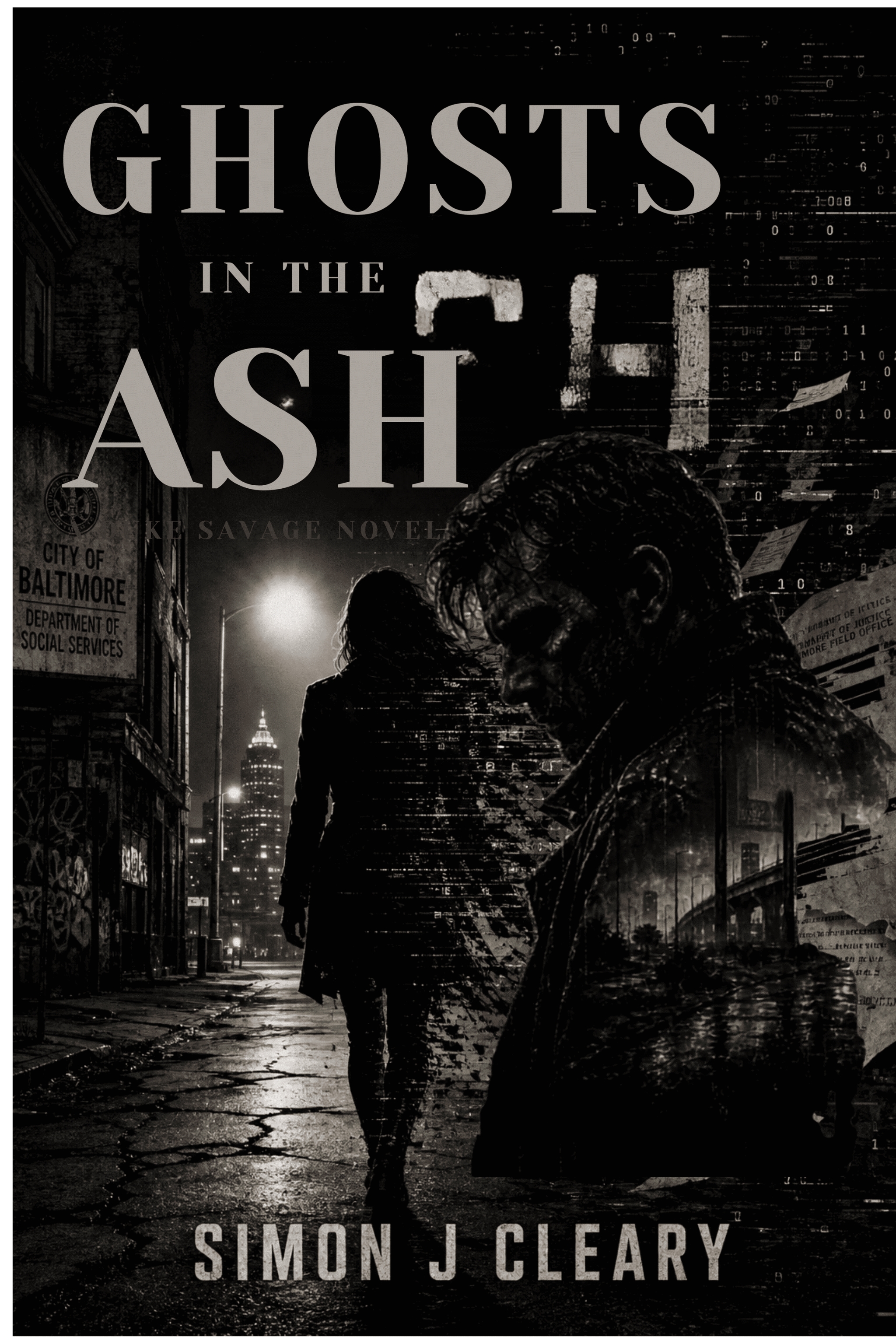
GHOSTSIN THEASH

In a city that erases people with a transposed digit, one investigator was hired to find a woman who was never meant to be found.

Published · The Duke Savage Trilogy · Book 01 of 03

Duke Savage is fifty-three — a former investigative journalist turned private investigator operating out of a cramped office above a pawnshop in Los Angeles. When an encrypted message warns him that a young woman is running out of time, he discovers Sarah Chu has been systematically erased from the administrative systems that govern modern life.

FILE 001 · DUKE SAVAGE · DEBUT

Ghosts in the Ash — A Duke Savage Novel by Simon J Cleary
THE DEBUT · NOW AVAILABLE
// THE TRILOGY · BOOK 01

Nobody broke the law. The law was the mechanism.

Twenty-seven drafts. A mechanism that learns to hide. The debut of the Duke Savage trilogy.

Published · Adult literary crime

Duke Savage is fifty-three — a former investigative journalist turned private investigator operating out of a cramped office above a pawnshop in Los Angeles. Estranged from his daughter Julie and struggling to stay ahead of the addictions and regrets accumulated across decades, Duke survives by taking the cases nobody else wants. When an encrypted message warns that a young woman is running out of time, he begins searching for Sarah Chu, a twenty-seven-year-old data analyst who appears to have vanished without explanation.

What he discovers is more disturbing than a disappearance: Sarah has been systematically erased from the administrative systems that govern modern life — employment records, housing data, medical access, financial history — transformed from a living person into what the system classifies as an administrative variance. The trail leads to Victoria Cross, a former insider exposing a powerful network known as the Babylon Circuit, which has developed a method for quietly displacing vulnerable people from valuable property corridors while remaining entirely within the law.

// PROLOGUE · OMAHA, 1999

The prologue from Ghosts in the Ash

The origin of everything that follows. The lamp that never goes out.

The house was a rental on Fontenelle Boulevard, the kind of property that existed in the kind of neglected rental where weeds choked the lawn and the furnace groaned like it was already spring. Two bedrooms, a yard that had given up, and the same furnace that ran three months behind the weather.

The man who lived there had been renting it for eleven months under a lease that was due for renewal in six weeks, though the lease would not be renewed. That had already been decided by people who would never see the property or know its address. The decision existed in a different document, in a different city, filed under a category that had no official name.

The street was quiet at 2 a.m. It was the kind of quiet that a Midwestern winter produced — not peaceful, but sealed. The cold kept people inside and kept sound close to the ground and kept the city's overnight processes running without witnesses.

The man inside the house had a daughter. Eight years old. She slept in the back bedroom with a lamp on — not from fear, but from habit, the specific comfort of a child who had learned that darkness was negotiable and light was a decision you could make for yourself. The lamp threw a warm stripe under the closed door. In the hallway, it looked like a signal.

The man was at his desk when they came through the door. He had a transcript in front of him, forty-three pages, double-spaced, the testimony of a man who had agreed to speak on the condition that his name would never appear in print and his family would never be endangered. The man at the desk had made all three promises. He had meant them. He had not yet understood that promises required infrastructure to keep, and that his infrastructure was already compromised.

The door came in on the second impact. Thirty seconds was enough. The man put the transcript in the furnace on his way through the kitchen. That was the right decision and he knew it and made it without hesitation, which was the last clean decision of the evening.

What followed was not clean. It lasted four minutes. The intention was communication. The message was: you are not protected. Your promises are not infrastructure. The story does not exist. The message was delivered.

What had not been factored — what existed in no document, no operational brief, no risk assessment — was the child. She appeared at the top of the stairs at the two-minute mark, drawn by the noise the way kids are drawn to anything that sounds wrong. She stood at the top of the stairs in her nightgown with the lamp light behind her and she looked down at the hallway. She could not tell them apart.

The variable had a daughter. The daughter had a wound now that had no name yet, that would take years to surface and longer to understand, that would express itself as distance and then as the specific vocabulary of a woman who had learned to say what she meant because the alternative — the elaborate interior architecture of not saying it — had been built by her father and she had watched what it cost him.

The men left. The man on the floor of his hallway got up. This was also noted — that he got up, that he always got up, that this quality in him was both his value and his problem. A man who didn't get up was a solved problem. A man who got up was a variable that required ongoing management.

He would require ongoing management for the next twenty-five years.

The transcript was ash. The informant would be dead in six days. The story did not run. The organisation noted the outcome in its records under the category it used for resolved operational risks: MANAGED. VARIABLE CONTAINED. MONITORING ONGOING.

The child went back to her room.

She left the lamp on.

Like what you read? The first chapter is on the house.

Read the rest — free
// WHERE TO READ IT

Buy Ghosts in the Ash

Paperback, ebook and audio. Years in the drafting, one night of work in the furnace.

Signed-copy drops go out to the dispatch list first.

// CASE FILE 001

Duke Savage

A working dossier on the investigator at the center of the trilogy. Compiled from case files, bar napkins, and the occasional 3 a.m. phone call.

Confidential

Subject Profile

FILE 001 · SAVAGE
Name
Duke Savage
Age
53
Formerly
Investigative journalist — a prodigy with a keyboard and a curse with a conscience. His exposés toppled mayors and vaporized criminal syndicates.
Now
Private investigator. A cramped office above a pawnshop, Los Angeles.
What broke him
The Heartland ring. He went deep undercover to get revenge, and the things he did to keep his cover came home as a chemical ghost. The blowback from his crusade shattered his daughter Julie's sense of safety. She survived. The light in her eyes didn't.
Kryptonite
Julie Savage. The one person who could ever make him hesitate, the one memory that can still cut him to the bone. Her absence is a wound that never closes. She still leaves a lamp on in the hall.
Motivation
He doesn't believe in justice anymore. He believes in exposure. He digs, he reveals, he wounds the beast — not because he thinks he can kill it, but because he can't stand the thought of letting it feed unchallenged. Every case is a penance.
Voice
A cocktail of Hunter S. Thompson's gonzo paranoia, James Ellroy's staccato brutality, and Chandler's weary lyricism. Dry. Sardonic. Never impressed — by power, by money, by evil. Only occasionally by honesty.
The case
Hired to find a missing woman. Discovers he wasn't hired to find her — he was selected. In a war fought with administrative cascades, Duke is the one variable the system cannot quietly resolve.
Updated: 2026.05.01Status: Active
// WHAT'S NEXT

The second novel is live

The city was not drowning them. It was mopping its floor.